

Fermented foods have been staples in almost all traditional cultures for millennia. Sauerkraut in Europe, Kimchi in Korea, Miso in Japan and Poi in Hawaii. It's a natural way of preserving food and provides beneficial microbes to the gut.
One of the daily foods at the Hippocrates Institute was sauerkraut and kim chi. Traditional sauerkraut and kimchi use a lot of salt though, and wanting to stay low-salt, Hippocrates makes theirs with no added salt.
So, this is what we'll share here. A salt-free kim chi that's both nutritious and delicious.
Join us to hear more.
So, if these fermented foods can be made without salt, what's the purpose of it in the first place?
It turns out that salt does more than simply make them taste salty.
One of the main things it does is to draw water out of the vegetables. The salt pulls water from the cabbage and other vegetables, and that creates the brine for the fermentation. This brine also helps keep the vegetables submerged and away from oxygen.
The salt also suppresses undesirable microbes. Many spoilage and potentially harmful organisms don't tolerate a salty, acidic environment very well so it keeps it from spoiling. It's a preservative.
The salty environment also favours lactic-acid bacteria, which are the kind we want. They convert vegetable sugars into lactic acid, lowering the pH and preserving the food.
Interesting, too, salt helps the cabbage remain crisp rather than turning soft and mushy.
So, there are a number of reasons for the salt other than the taste. With this in mind, as we decrease the amount of salt in a recipe, temperature, cleanliness, and keeping everything submerged is important.
If you're wanting to keep your sodium intake low and still have fermented foods like sauerkraut and kim chi, give this a try. And let us know what you think.
To you Amazing Health,
Connie and Bill
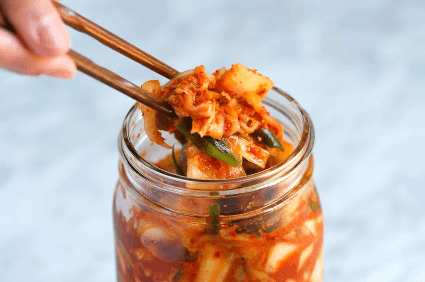
Salt-Free Kim Chi (makes 1 quart) adapted from Hippocrates Institute
Sauce:
- 1½ cups red pepper, cut in large pieces
- ½ cup carrots, cut in chunks
- 1 whole habanero or 1 Jalapeno pepper--add a few seeds for heat
- ½ cup red onion, cut in chunks
- 2 tablespoons fresh ginger, cut in chunks
- 3 tablespoons kombu soaking water, see below
- 2 garlic cloves
- 4-inch piece of soaked kombu—instructions below
Place everything in high-speed blender and blend until it becomes a sauce, about 60 seconds.
Veggies:
- ½ head Napa cabbage, sliced in 1-inch-wide slices
- ¾ cup red pepper, cut into 1-inch pieces
- 1 jalapeño pepper, seeded and cut in small pieces
- 1 cup carrots, sliced into matchsticks
- ½ cup daikon radish, sliced into matchsticks
- ½ cup red onion, sliced into thin pieces
NOTE: Save two large outer cabbage leaves to cover over seaweed at top of Kim Chi when assembling in the crock or jar.
To add later:
- ½ apple, cored and seeded
- 6 or 7 pieces of Kombu seaweed, soaked in filtered water with the kombu for the sauce, to cover top of Kimchi.
Mix cabbage, carrot, peppers, jalapeño, daikon and red onion in a large bowl.
Massage the sauce into the cabbage and veggie mixture with your hands.
Put half the cabbage and veggie mixture in a glass container or ceramic crock.
Now place the apple in the center of the cabbage and veggie mixture, add the remaining cabbage mixture, always pressing down firmly.
Cover cabbage and veggie mixture with hydrated Kombu strips.
Now add a layer of the large outer cabbage leaves.
Press everything down until the brine comes up above the ingredients.
Place a rock on top of cabbage leaves, keeping everything submerged. You can use the weight of the rock to hold it down or, if you have a jar with a spring-loaded lid, use a piece of carrot or daikon to push it down as you close and lock the lid.
Leave out at room temperature.
The Kim Chi will begin to foam and bubble as it ferments, so we always set it on a plate.
Let stand 3-5 days until it tastes fermented.
Discard cabbage leaves, Kombu and apple in the middle.
Place in refrigerator for storage.
NOTE: This is a Korean-style kim chi. It’s spicy, boosts the immune system and helps with digestion. We use a fresh hot pepper which is great for its health benefits as well as spice.
If available, we like to add a bit of bok choy to it for a nice contrast in colour.