

We're continuing our discussion of three common principles found in major religions and spiritual teachings: Non-Resistance, Non-Judgement, and Non-Attachment.
We want to explore these more deeply because they so profoundly influence the experience we have in our lives and relationships. This week we'll talk about Non-Judgement.
Join us to hear more.
Last week we talked about Non-Resistance and how our lives are so dramatically affected when we resist what shows up. We find that true of judgment as well.
Whenever I look at a situation as good or bad, right or wrong, I feel a tightness come over me. And if I reflect, I see how my perspective is affected by that judgement. I'm more close-minded and defensive. I also see how interacting with others from this judgemental attitude never produces the most beneficial outcomes.
Now, we aren't suggesting that one choice we make isn't more beneficial than another. We naturally want to respond to life in ways that create the best outcomes. But the question here is whether we need to add a layer of judgement to do this. Do we need to see things as right or wrong to do this?
We have always encouraged people to recognize that circumstances are neutral. But being neutral doesn't mean that different responses don't create different experiences for us.
It's the natural function of the mind to analyze and compare. And this leads to discerning the different consequences of our choices, which is how we develop our preferences. I like chocolate nice cream and my brother likes vanilla. It's natural to prefer one thing over another. What we're exploring here though is whether we need to see our differences as right and wrong to make the best decisions.
Our minds are naturally discerning. That's an important function. But when we add the meaning or thought that something is good or bad, right or wrong, we're adding an extra layer of thinking to what's happening. It takes us beyond a preference to a should.
We'll all have different opinions and preferences in our lives, but these differences don't mean we have to lose our sense of closeness with others or our inner sense of well-being and peace. As long as we don't add that extra layer of judgement, tell ourselves a story of what's right and what's wrong about it, we can respond with love and understanding. And this loving response can take the form of agreement or disagreement. But we don't end up in a fight or argument with the other person or life itself.
Often though, we get triggered and are in judgement before we know it. What we recommend in this situation is that you use the upset like getting a tap on the shoulder for you to see that you're adding a layer of judgement. And when you notice that, relax, take a breath, or whatever allows you to open, and see the situation with more perspective, free of the judgement.
It's like setting down a snow globe. When we stop thinking about a situation and just pause, our minds settle down, our bodies settle down and we begin to feel and see things much differently. Much more broadly and with a greater understanding for both points of view.
You might give this a try the next time you find yourself upset or being judgemental. See if you can settle down and gain more perspective to respond from. And see if this isn't a real benefit in becoming more non-judgemental.
The recipe this week is a Blueberry Millet Muffin. It's an adaptation for a muffin on Dr. John McDougall's website that uses millet and lemon to enhance the texture and flavor of the blueberries. It has quickly become our favorite muffin!
To your Amazing Health,
Connie and Bill
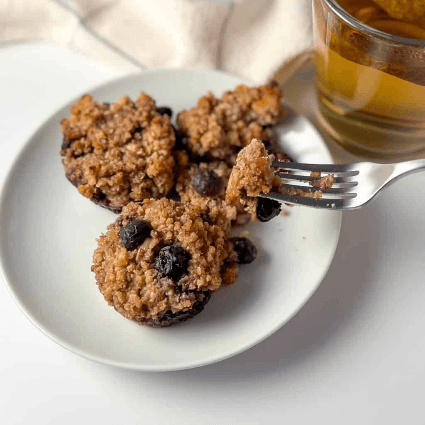
Blueberry Millet Muffins Adapted from Cathy Fisher’s recipe on drmcdougall.com
- 12 dates (Deglet Noor), pitted
- 1½ cups rolled oats
- ¾ cup millet (dry) or millet flour
- 2 tablespoons baking powder
- ¼ teaspoon ground cardamom
- ¼ teaspoon cinnamon
- 1 ripe banana
- zest of ½ lemon
- juice of ½ lemon
- 1 cup non-dairy milk
- 1 cup fresh or frozen blueberries (if frozen do not thaw first)
- ½ cup chopped walnuts
Preheat oven to 350º.
Add dates to a food processor and process to a coarse chunkiness, but don’t let them ball up.
Add the oats and millet (or millet flour) and process to a chunkiness you like. The finer the oats, the denser the muffin.
Add the baking powder, cardamom and cinnamon and pulse to mix in.
Add the banana, lemon zest and juice and mix well.
Add the milk and pulse to mix in well.
Pour the batter into a bowl and fold in the blueberries and chopped walnuts.
Spoon the batter into a silicone muffin pan or metal muffin pan lined with parchment paper liners, filling each muffin cup about ¾ full.
Bake for 25 to 30 minutes. The muffins will be done when the tops have begun to brown and when a toothpick inserted comes out pretty clean. (These are hearty muffins, so they will rise but not too much.)
Let cool in the pan for 10-15 minutes before removing.
NOTE: The muffins have a lovely crunchiness when using the dry millet and have more of a traditional texture when using millet flour.